Smart Garden vs. Hydroponic System: Which is Right for 2026 Urban Living?
Choosing between a smart garden and a traditional hydroponic system for urban living in 2026 depends on your priorities: convenience, control, cost, and commitment. Both methods let you grow fresh produce indoors, but they offer very different experiences. I have set up and maintained both types in my own apartment, dealing with everything from nutrient film technique (NFT) clogs to smart garden app glitches.
What is a Smart Garden?
A smart garden is an integrated, often compact, indoor growing system. It automates most aspects of plant care. These systems typically include built-in LED grow lights, self-watering reservoirs, and pre-seeded pods with specific nutrient formulations. Many connect to a smartphone app for monitoring and control.
Pros:
- Ease of Use: Smart gardens are designed for beginners. You plug it in, add water, drop in seed pods, and the system handles the rest. This is great if you have a busy schedule or lack gardening experience.
- Automation: Lighting schedules, watering cycles, and nutrient delivery are often pre-programmed or managed through an app. This reduces daily chores significantly.
- Compact Footprint: Many models are sleek and fit well on kitchen counters or small shelves. An advanced system like the Gardyn Home Kit 3.0, for example, produces up to 30 lbs (13.6 kg) of produce annually in just 2 sq ft (0.19 sq m) of floor space.
- Cleanliness: These systems are generally very clean, with minimal soil or mess.
- Higher Upfront Cost: A mid-range smart garden system (e.g., AeroGarden Farm 24XL, Click & Grow Smart Garden 27) costs around $780 USD in 2026, including initial seed pods and nutrients. This is often more expensive than basic hydroponic setups.
- Limited Customization: You are usually restricted to the manufacturer's specific seed pods and nutrient solutions. This limits your plant choices and ability to fine-tune growing conditions.
- Proprietary Consumables: Seed pods and nutrient refills are often proprietary, meaning you must buy them from the system's manufacturer. This adds to long-term costs.
- Reliance on Technology: If the app disconnects or hardware fails, remote monitoring and control stop. I have personally experienced app connectivity issues with a smart garden, which meant I could not check water levels or light schedules without being physically present.
What is a Hydroponic System?
A hydroponic system grows plants without soil, using nutrient-rich water solutions. There are several types suitable for home use, including Deep Water Culture (DWC), Nutrient Film Technique (NFT), and ebb and flow systems. These systems typically involve a reservoir, a pump, tubing, and growing containers.
Pros:
- Greater Control: You have full control over nutrient formulations, pH levels, water temperature, and light cycles. This allows for optimization for specific plant types and maximum yields. Optimal water temperature for most leafy greens and herbs is between 65-72°F (18-22°C), which you can actively manage in a custom system.
- Higher Yield Potential: With proper management, hydroponic systems often produce faster growth and higher yields compared to soil gardening or even some smart gardens, especially for larger plants.
- Versatility: You can grow a wider variety of plants, from leafy greens and herbs to fruiting plants like tomatoes and peppers, using standard seeds and growing media.
- Lower Upfront Cost (Basic): Basic hydroponic kits for 6-12 plants start around $350 USD. This excludes grow lights and environmental controls, which you often need to buy separately.
- Educational Value: Setting up and managing a hydroponic system teaches you a lot about plant physiology and nutrient management. The USDA National Agricultural Library has extensive resources on hydroponics.
- More Complex Setup & Maintenance: The initial setup can be daunting, requiring assembly of pumps, tubing, and grow trays. "The initial setup for my hydroponic system was way more complicated than I expected," is a common complaint. Regular tasks include checking pH, nutrient levels, and cleaning reservoirs to prevent algae.
- Requires More Knowledge: Understanding nutrient ratios, pH balance, and plant needs is crucial for success. Incorrect nutrient levels or pH can quickly kill plants. Purdue University Extension offers a helpful guide for home hydroponic gardeners.
- Algae Growth: Algae is a persistent problem in hydroponic systems, especially if light hits the nutrient solution. "I'm constantly battling algae growth in my hydroponic reservoir," is a frequent user issue. This requires regular cleaning and light-blocking measures.
- Space & Aesthetics: Many DIY or basic hydroponic setups are less aesthetically pleasing than smart gardens and can take up more space, especially when you factor in external grow lights and pumps.
- Energy Consumption: While often seen as more sustainable, hydroponic systems can consume significant energy, especially if you add powerful grow lights, air pumps, water pumps, and environmental controls like heaters or chillers to maintain optimal conditions. A 12-plant smart garden uses about 0.8 kWh per day, costing about $0.16 USD daily at 2026 rates, but a larger, more complex hydroponic system with external lighting can easily exceed this.
Key Differences at a Glance
Here is a direct comparison to help you weigh your options:
| Feature | Smart Garden (e.g., AeroGarden, Click & Grow) | Hydroponic System (e.g., DWC, NFT kit) |
|---|---|---|
| Upfront Cost | ~$780 USD (mid-range, includes pods/nutrients) | ~$350 USD (basic kit, excludes lights/controls) |
| Ease of Use | Very high; mostly automated, plug-and-play | Moderate to low; requires assembly, monitoring, and knowledge |
| Customization | Low; proprietary pods, limited plant types | High; use any seeds, custom nutrient solutions, wide plant variety |
| Maintenance | Low; refill water/nutrients occasionally, clean every few months | Moderate to high; daily/weekly pH/EC checks, reservoir cleaning, algae control |
| Yield Potential | Moderate; good for herbs/leafy greens, limited by system size | High; can be scaled for significant production, faster growth rates |
| Energy Use | ~0.8 kWh/day for 12 plants (built-in lights) | Variable; depends on lights, pumps, environmental controls (can be higher) |
| Footprint | Compact; designed for countertops | Variable; can be compact or expand to fill larger spaces |
| Learning Curve | Very low | Moderate to high |
| Consumables | Proprietary seed pods, nutrient solutions | Standard seeds, bulk nutrients, growing media (rockwool, coco coir) |
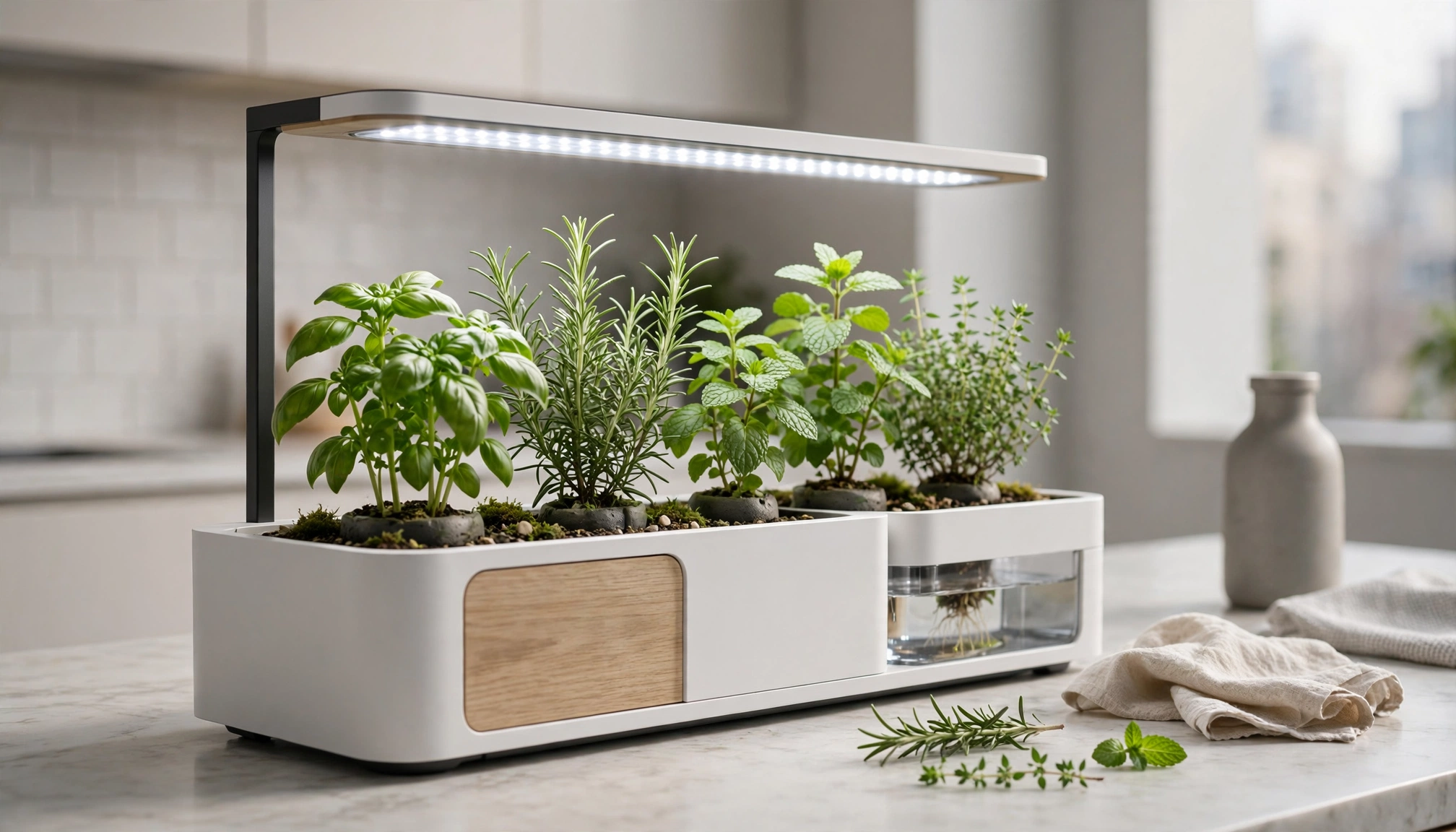
A sleek, modern smart garden on a kitchen counter, growing various herbs under integrated LED lights.
Energy Consumption and Sustainability
Many people believe hydroponic systems are inherently more sustainable than smart gardens. This is a common misconception. While hydroponics uses significantly less water than traditional soil gardening (up to 90% less according to the USDA), the energy footprint can be substantial.
A typical 12-plant smart garden system, running its integrated lights for 16 hours a day, consumes about 0.8 kWh daily. At the 2026 national average electricity rate of $0.20/kWh, this costs about $0.16 USD per day.
For a hydroponic system, especially one designed for higher yields, you often add more powerful external grow lights, air pumps for oxygenating the water, and sometimes water heaters or chillers to maintain the optimal 65-72°F (18-22°C) water temperature. These additions increase energy consumption considerably. For example, a 300W LED grow light running 16 hours a day uses 4.8 kWh daily, costing $0.96 USD per day just for lighting. When you add pumps and climate control, the energy cost can easily surpass that of a smart garden.
The market for indoor farming technology, including both smart gardens and hydroponics, is projected to reach $28.5 billion globally by the end of 2026, indicating strong growth in both sectors. This growth is driven by the desire for fresh, local produce and the increasing urbanization of populations.
A more complex DIY hydroponic setup with PVC pipes, a reservoir, and separate LED grow lights, showing various leafy greens.
Which is Right for You?
Choose a Smart Garden if:
- You prioritize convenience and automation. You want to set it up and largely forget about it, with minimal daily interaction.
- You are new to gardening. The guided process and pre-portioned consumables make it very beginner-friendly.
- You have limited space and want a clean, aesthetic system. Smart gardens often blend well with modern urban interiors.
- You primarily want to grow herbs and leafy greens. These systems excel at smaller, faster-growing plants.
- Your budget allows for the higher upfront cost and proprietary consumables.
- You enjoy hands-on gardening and learning. You want to understand the science behind plant growth and actively manage conditions.
- You seek higher yields and greater plant variety. You want to grow larger plants or a wider range of produce, including fruiting vegetables.
- You want full control over nutrient solutions and growing parameters. You are willing to invest time in monitoring pH, EC, and nutrient levels.
- You are comfortable with a more complex setup and maintenance routine. This includes regular cleaning to prevent issues like algae growth.
- You are looking for a potentially lower initial investment (for basic systems) and cheaper long-term consumable costs (using bulk nutrients and seeds).
Frequently Asked Questions
How much space do these systems actually need?
A typical smart garden like a Click & Grow Smart Garden 9 needs about 12x15 inches (30x38 cm) of counter space. Larger smart gardens, such as the AeroGarden Farm series, can take up to 18x36 inches (46x91 cm) and stand several feet tall. Basic home hydroponic systems (like a 6-plant DWC bucket system) can fit in a similar footprint, but often require additional space for external grow lights and a separate nutrient reservoir. A vertical NFT system for 10-12 plants might need a 2x2 ft (0.6x0.6 m) floor space but stands 4-5 ft (1.2-1.5 m) tall.
Can I grow anything in these systems?
Smart gardens are generally limited to the manufacturer's specific seed pods, which usually include herbs, leafy greens, and some small fruiting plants like cherry tomatoes or peppers. Hydroponic systems offer much more versatility. You can grow almost any plant that thrives in a soilless environment, from various herbs and greens to larger vegetables like cucumbers, bell peppers, and even strawberries, as long as you provide adequate light, nutrients, and support.