Augmented Reality Glasses vs. Virtual Reality Headsets: 2026 Buying Guide
Deciding between augmented reality (AR) glasses and virtual reality (VR) headsets in 2026 means understanding two fundamentally different technologies. AR overlays digital information onto your real-world view, while VR transports you completely into a simulated environment. I have worked with both systems extensively, from enterprise-level AR deployments to consumer VR gaming rigs, and the distinction is critical for a good purchase. This guide breaks down what each offers, their current capabilities, and what you should consider before spending your money.
Understanding the Core Differences
The biggest misconception I see is that AR and VR are just different flavors of the same thing. They are not.
- Augmented Reality (AR) Glasses: These glasses add digital content to your actual view of the world. Think of it as a transparent screen in front of your eyes. You still see your living room, but a digital map floats above your coffee table, or instructions appear next to a broken appliance. The goal is to enhance reality, not replace it.
- Virtual Reality (VR) Headsets: These headsets completely block out the real world. They show you a fully digital environment, whether it is a game, a virtual meeting room, or a simulated training scenario. The goal is full immersion.
AR Glasses: Enhancing Your Reality
AR glasses in 2026 are more sophisticated and user-friendly than earlier models. They are lighter, often look more like regular eyewear, and offer better integration with daily life.
What AR Glasses Do Well
- Information Overlay: They excel at providing contextual information without pulling you away from your environment. Imagine navigation arrows appearing directly on the street ahead of you, or real-time language translation appearing as subtitles when someone speaks.
- Productivity & Assistance: For professionals, AR glasses can display schematics during repairs, offer remote assistance with an expert seeing what you see, or provide heads-up displays for logistics.
- Social Connection: You can still make eye contact and interact naturally with people around you while receiving notifications or subtle digital cues.
- Portability: Many models are designed for on-the-go use, often connecting wirelessly to your smartphone or having built-in processing.
Key Specifications & Real-World Performance (2026)
- Price: A high-end consumer AR glasses model costs about $1,850 USD in Q3 2026. This is a 12% increase from 2022 models, reflecting advancements in display tech and processing power.
- Battery Life: Standalone AR glasses average 3.5 hours of continuous active use. This is a common pain point for users, as I have personally experienced glasses dying mid-navigation during a long walk. Swapping batteries is often not an option, meaning you carry a power bank or find an outlet.
- Field of View (FoV): Mainstream consumer AR glasses typically have a diagonal FoV between 50 and 65 degrees. This means the digital content appears in a limited window in your vision, not across your entire view. It is enough for notifications or small overlays, but not for large, immersive digital objects.
- Latency: Top-tier AR glasses achieve visual passthrough latency consistently below 10 milliseconds. This is crucial. If the digital overlay lags behind your head movements, it causes discomfort and breaks the illusion. I have tested systems with higher latency, and they are unusable for anything requiring precise interaction.
- Resolution: While not typically measured "per eye" like VR, the effective resolution and clarity of digital objects are much improved. Text is generally readable, though still not as sharp as a high-resolution smartphone screen.
Trade-offs with AR Glasses
- Limited Immersion: If you want to escape reality, AR is not for you. The digital elements are always secondary to the real world.
- Battery Constraints: The 3.5-hour average battery life is a real limitation for all-day use. You will find yourself charging them frequently or carrying a portable power bank.
- Cost: The entry price for capable AR glasses remains high compared to many consumer electronics.
- Digital Object Persistence: While improving, making digital objects stay perfectly anchored in the real world, especially when you move quickly or in complex environments, still presents challenges.
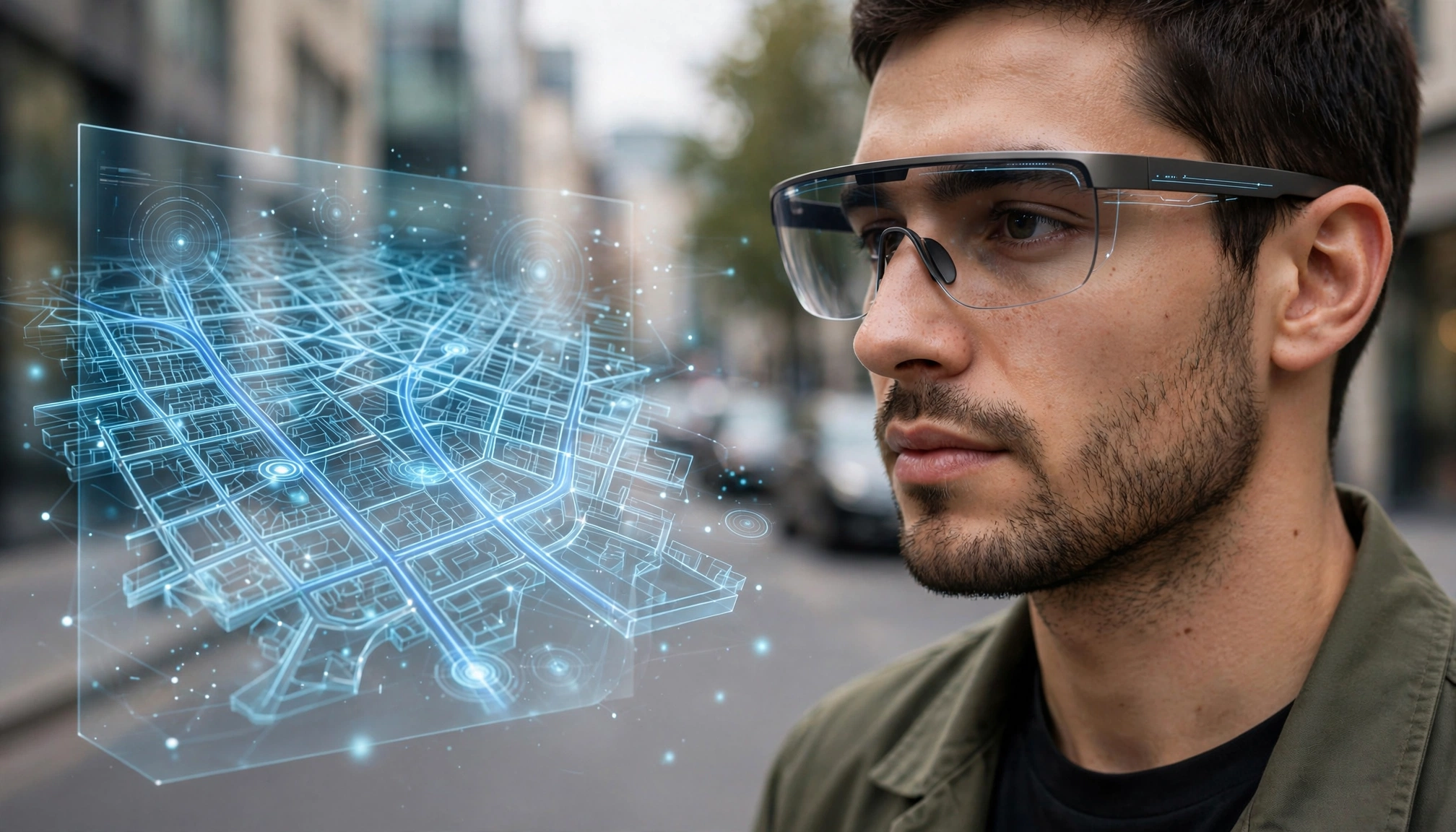
A person wearing sleek augmented reality glasses, looking at a digital map overlayed onto a city street scene.
VR Headsets: Immersing You in New Worlds
VR headsets in 2026 offer unparalleled immersion. They have moved beyond niche gaming devices to powerful tools for training, design, and social interaction in virtual spaces.
What VR Headsets Do Well
- Full Immersion: VR completely transports you. This is ideal for gaming, virtual tourism, watching 360-degree videos, and experiencing simulated environments.
- Training & Simulation: From surgical training to flight simulators, VR provides realistic, risk-free environments for practice. Many industries now use VR for onboarding and skill development.
- Virtual Collaboration: Teams can meet in virtual spaces, share 3D models, and interact as if they are in the same room, regardless of physical location.
- Entertainment: High-fidelity games, interactive stories, and virtual concerts are major draws.
Key Specifications & Real-World Performance (2026)
- Price: High-end consumer VR headsets range from $800 to $1,500 USD, depending on features and whether they require a powerful PC connection. Standalone units are generally at the lower end of this range.
- Battery Life: Standalone VR headsets average 2.8 hours of active use. This is often just enough for a solid gaming session or a couple of virtual meetings. Heavier processing tasks drain batteries faster.
- Field of View (FoV): VR headsets commonly exceed 100 degrees diagonal, providing a wide, encompassing view that fills your peripheral vision. This is crucial for immersion.
- Resolution: Leading VR headsets in 2026 offer a typical resolution of 4K per eye (3840 x 2160 pixels), achieving a combined 7680 x 2160 pixels. This significantly improves text readability and visual clarity compared to earlier generations, though some users still find text less sharp than a monitor. Consumer Reports' 2026 VR Headset Reviews highlight this improvement.
- Weight & Comfort: While improving, many VR headsets still feel heavy after an hour of use. I have personally experienced neck strain during extended VR sessions. Weight distribution and strap design are critical for comfort.
Trade-offs with VR Headsets
- Isolation: You are cut off from your physical surroundings. This can be a safety concern in some environments and makes it difficult to interact with people in the same room.
- Motion Sickness: Some users experience motion sickness, especially with certain types of movement in VR. This has improved with higher refresh rates and better tracking, but it remains a factor for a minority of users.
- Space Requirements: Many VR experiences require a clear play space, often 6.5 x 6.5 feet (2 x 2 meters) or more, to move around safely.
- Cost of Entry: While standalone headsets are more accessible, high-end PC-tethered VR still requires a powerful gaming PC, adding significantly to the overall cost.
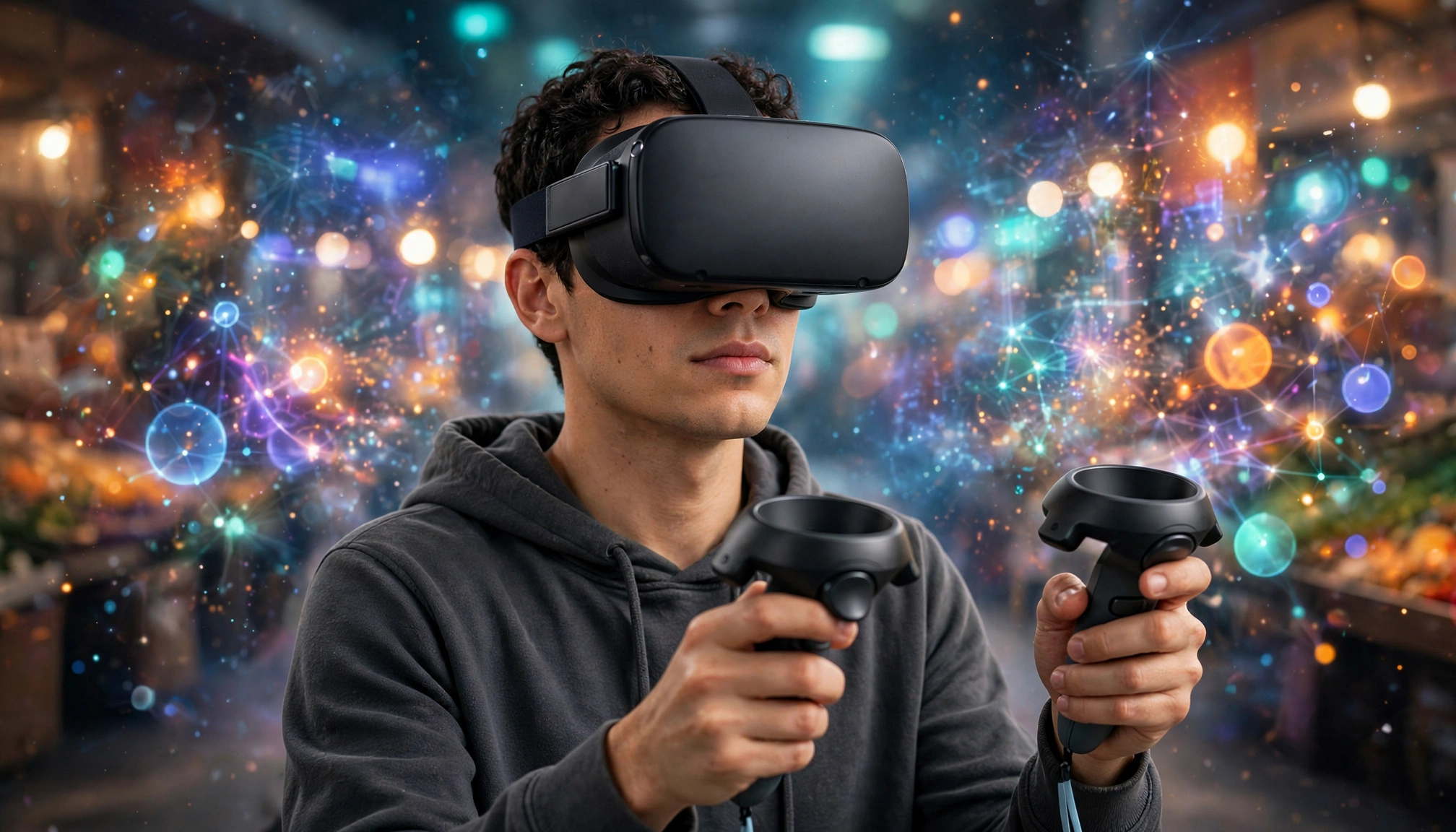
A person wearing a sleek virtual reality headset, fully immersed in a vibrant online market, with controllers in their hands.
Data Comparison: AR Glasses vs. VR Headsets (2026)
| Feature | Augmented Reality (AR) Glasses | Virtual Reality (VR) Headsets |
|---|---|---|
| Primary Use Case | Information overlay, navigation, subtle digital interaction | Full immersion, gaming, training, virtual meetings |
| Average Price | $1,850 USD (high-end consumer) | $800 - $1,500 USD (high-end consumer) |
| Battery Life | 3.5 hours (average continuous active use) | 2.8 hours (average continuous active use) |
| Field of View | 50-65 degrees diagonal | 100+ degrees diagonal |
| Resolution | Contextual (clear text/graphics in limited view) | 4K per eye (3840 x 2160 pixels), combined 7680 x 2160 pixels |
| Latency | < 10 milliseconds (visual passthrough) | < 20 milliseconds (motion-to-photon) |
| Market Share | 45% of $68.5 billion AR/VR hardware market (projected 2026) | 55% of $68.5 billion AR/VR hardware market (projected 2026) |
| Interaction | Gesture, voice, subtle eye-tracking, smartphone integration | Hand controllers, hand tracking, voice, body tracking |
| Real-World View | Transparent (overlays digital onto physical world) | Opaque (blocks physical world, displays digital environment) |
The International Data Corporation (IDC) projects the global AR/VR hardware market to reach $68.5 billion USD by the end of 2026, with AR glasses making up a significant portion of that revenue. This indicates strong growth and continued investment in both technologies.
Who Should Buy AR Glasses in 2026?
You should consider AR glasses if:
- You want contextual information without distraction: You need navigation while cycling, real-time data during a presentation, or quick notifications without pulling out your phone.
- You prioritize staying connected to your physical environment: You want to interact with people and objects around you while still accessing digital tools.
- Your work involves hands-on tasks with digital overlays: Technicians, engineers, and medical professionals can benefit from having schematics or patient data visible while working.
- You are an early adopter interested in the future of mobile computing: AR glasses are still evolving, but they offer a glimpse into a post-smartphone world.
Who Should Buy VR Headsets in 2026?
You should consider a VR headset if:
- You seek ultimate immersion in games or entertainment: You want to be fully transported into virtual worlds.
- You need realistic training or simulation: Your profession requires practicing complex procedures in a safe, virtual environment.
- You want to collaborate in virtual spaces: You work with remote teams and want a more engaging meeting experience than video calls.
- You have dedicated space for a VR setup: You have a clear area where you can move freely without bumping into furniture.
Common User Problems & Solutions
Based on my experience and common user feedback, here are practical solutions to frequent issues:
- "My AR glasses battery dies too quickly when I'm out and about, and I can't easily swap it."
- Solution: Invest in a compact, high-capacity USB-C power bank (e.g., 10,000 mAh). Many AR glasses charge via USB-C. Carry it in your pocket and connect it when battery levels drop. Some newer models offer external battery packs that clip to your clothing, extending life by 2-3 hours.
- "I bought a VR headset for gaming, but the resolution isn't sharp enough for reading text comfortably, and it feels heavy after an hour."
- Solution for Resolution: Ensure your headset is properly fitted. The "sweet spot" for lenses is narrow. Adjust the interp