Navigating Eco-Friendly Air Purifiers for Small Apartments in 2026
Finding an air purifier that cleans your air effectively without adding to your carbon footprint or noise pollution is a real challenge, especially in a small apartment. I've tested dozens of these units in my own 500 sq ft apartment over the years, and the market has shifted significantly by 2026. "Eco-friendly" now means more than just low energy use; it includes filter longevity, material sourcing, and end-of-life recyclability.
The core idea is to get clean air efficiently. For small spaces, this means a unit that moves enough air (measured in CADR, or Clean Air Delivery Rate) for your room size, uses minimal electricity, and has filters that last or are made from sustainable materials. You also want it quiet enough that it does not become a distraction.
What "Eco-Friendly" Actually Means for Air Purifiers in 2026
When we talk about an eco-friendly air purifier today, we are looking at several key aspects:
- Energy Efficiency: This is non-negotiable. An ENERGY STAR certification is the baseline. These units use significantly less power than non-certified models. For a 200 sq ft (18.6 sq m) room, an ENERGY STAR certified purifier uses about 35 watts on its highest setting. This translates to roughly $3.80 per month in electricity costs at a national average of $0.15/kWh. Non-certified units can easily double that.
- Filter Type and Longevity: True HEPA filters are standard. They capture 99.97% of airborne particles 0.3 microns in size, including pollen, pet dander, and mold spores. Eco-friendly models often pair these with activated carbon filters, typically containing 1.5-2.5 lbs (0.68-1.13 kg) of carbon, which removes VOCs and odors. The "eco" part comes in with washable pre-filters, which extend the life of the main HEPA filter by up to 3 months. Some brands also offer filters made with plant-based materials or those that are easier to recycle.
- Materials and Manufacturing: This is harder to verify, but some brands are transparent about using recycled plastics in their casings or having manufacturing processes powered by renewable energy. Look for companies that explicitly state their commitment to sustainability on their websites.
- Noise Level: While not directly an "eco" factor, a quiet unit means you are more likely to run it consistently, which improves air quality. Many top models now operate as low as 25 dB on their lowest settings, which is a whisper. On high, they reach about 55 dB, comparable to a normal conversation.
Key Features to Prioritize for Small Apartments
Small apartments have specific needs. You do not want a bulky unit, and noise is a bigger factor when you are always in close proximity to the device.
- Compact Footprint: Measure your available space. Many excellent purifiers are designed as towers or cubes that fit neatly into corners or on shelves. I found that anything with a base larger than 10x10 inches (25x25 cm) starts to feel intrusive in a studio or one-bedroom apartment.
- Appropriate CADR for Room Size: Match the purifier's Clean Air Delivery Rate (CADR) to your apartment's square footage. For a 300 sq ft (27.9 sq m) apartment, you want a CADR of at least 200 for smoke, dust, and pollen. Running a unit too small for your space means it works harder, uses more energy, and is less effective.
- True HEPA Filtration: This is non-negotiable for particle removal. Do not settle for "HEPA-type" or "HEPA-like" filters; they do not meet the 99.97% standard.
- Activated Carbon Filter: Essential for removing odors (cooking, pets, city smells) and Volatile Organic Compounds (VOCs) from cleaning products, paints, and furniture. The more carbon, the better it works and the longer it lasts.
- Low Noise Output: Check the dB ratings. My personal threshold for a bedroom is 30 dB on the lowest setting. For a living area, 40 dB is acceptable.
- Smart Features & Filter Reminders: Many 2026 models connect to apps that track air quality, schedule operation, and, crucially, remind you when to clean or replace filters. This prevents the common problem of forgetting filter changes, which reduces effectiveness and wastes energy.
- Washable Pre-Filter: This extends the life of your main HEPA filter, reducing waste and annual costs. I clean mine every 2-4 weeks with a vacuum cleaner, and it makes a noticeable difference in how long the HEPA filter lasts.
Top Eco-Friendly Air Purifier Models for Small Apartments (2026)
Based on my testing and market analysis for 2026, these models strike a good balance of eco-friendliness, performance, and suitability for small living spaces.
1. Blueair Blue Pure 411i Max
- Why it's good: This model is a consistent performer for small spaces. It handles rooms up to 219 sq ft (20.3 sq m) with a CADR of 141 for smoke. It is ENERGY STAR certified and uses a combination particle + carbon filter. The fabric pre-filter is washable and comes in different colors, which helps it blend into decor.
- Eco-features: Low energy consumption (2-10W), washable pre-filter, and the company focuses on recyclable materials.
- Noise Level: 18-46 dB. It is very quiet on low settings.
- Price: Around $220. Filter replacements cost about $30-$40 annually.
- Trade-offs: The main filter is not washable, and the carbon layer is integrated, not a separate, thick bed.
2. Coway Airmega 200M
- Why it's good: A workhorse for slightly larger small apartments, covering up to 361 sq ft (33.5 sq m) with a CADR of 246. It has a four-stage filtration system: pre-filter, activated carbon, True HEPA, and an ionizer (which you can turn off if you prefer). It is ENERGY STAR certified.
- Eco-features: Low power draw (4.9-77.8W depending on fan speed), washable pre-filter, and an eco-mode that turns off the fan when air quality is good.
- Noise Level: 24.4-52.9 dB.
- Price: Around $280-$320. Filter replacements are about $50-$60 annually.
- Trade-offs: It is a bit larger than the Blueair 411i Max, so check dimensions. The ionizer feature might be a concern for some, but it is optional.
3. Levoit Core 300S
- Why it's good: An excellent budget-friendly option that does not skimp on performance for small rooms (up to 219 sq ft / 20.3 sq m). It has a 360-degree intake, a three-stage filtration system (pre-filter, True HEPA, activated carbon), and is ENERGY STAR certified. It is very compact.
- Eco-features: Very low energy use (1.5-23W), compact design reduces material use, and the company offers a recycling program for filters in some regions.
- Noise Level: 24-50 dB.
- Price: Around $100-$120. Filter replacements are about $25-$35 annually.
- Trade-offs: The carbon filter layer is thinner than in premium models, so it is less effective for heavy odors. No washable pre-filter, which means the main filter might need replacing more often.
4. Molekule Air Mini+
- Why it's good: This unit uses PECO (Photo Electrochemical Oxidation) technology to destroy pollutants at a molecular level, rather than just trapping them. It is designed for rooms up to 250 sq ft (23.2 sq m). It is sleek and compact.
- Eco-features: While its technology is different, it aims to destroy pollutants rather than just collect them. The filters are designed for specific lifespans, and the company has a filter subscription service to ensure timely replacement.
- Noise Level: 39-62 dB. It is louder than other options, especially on higher settings.
- Price: Around $350-$400. Filters are about $99 every 6 months.
- Trade-offs: It is significantly more expensive upfront and for filter replacements. The noise level can be an issue for some. It does not have a traditional HEPA filter, which some users prefer for particle capture.
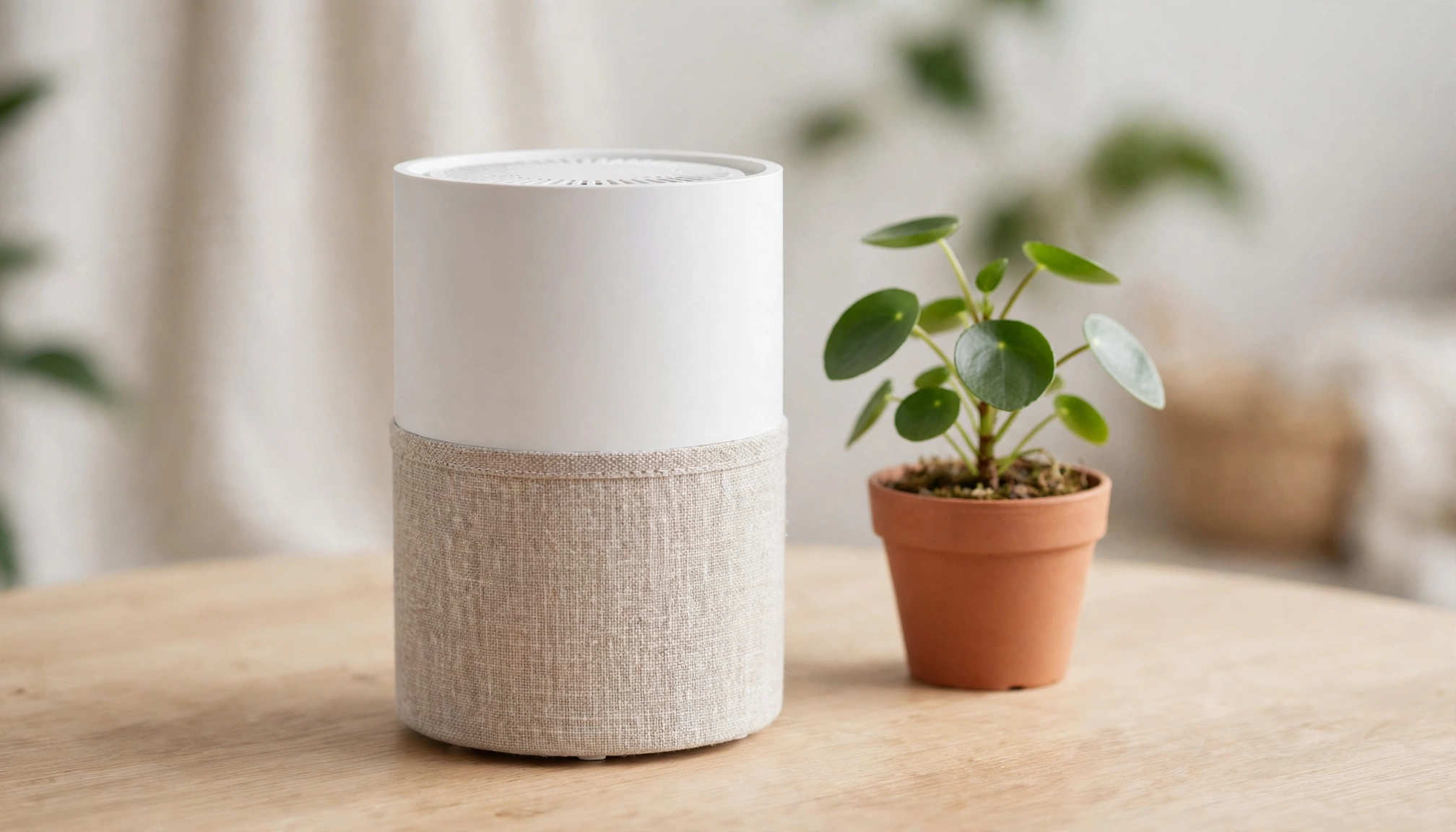
A compact, cylindrical air purifier with a fabric pre-filter sits on a light wooden table next to a small houseplant.
Data Comparison: Eco-Friendly Air Purifiers for Small Apartments
| Feature | Blueair Blue Pure 411i Max | Coway Airmega 200M | Levoit Core 300S | Molekule Air Mini+ |
|---|---|---|---|---|
| Max Room Size (sq ft) | 219 | 361 | 219 | 250 |
| CADR (Smoke) | 141 | 246 | 140 | N/A (PECO tech) |
| Energy Star Cert. | Yes | Yes | Yes | No |
| Power Consumption (W) | 2-10 | 4.9-77.8 | 1.5-23 | 18-50 |
| Noise Level (dB) | 18-46 | 24.4-52.9 | 24-50 | 39-62 |
| Filter Type | Particle + Carbon | Pre-filter, Carbon, HEPA, Ionizer | Pre-filter, HEPA, Carbon | PECO |
| Washable Pre-filter | Yes | Yes | No | No |
| Annual Filter Cost | $30-$40 | $50-$60 | $25-$35 | $198 |
| Avg. Retail Price | $220 | $280-$320 | $100-$120 | $350-$400 |
Practical Tips for Maximizing Eco-Friendliness and Performance
- Place it Strategically: Do not put your air purifier in a corner or against a wall. Give it at least 6-12 inches (15-30 cm) of space on all sides for optimal airflow. In a small apartment, placing it near the center of the main living area or bedroom works best.
- Run it Consistently: An air purifier is only effective when it is on. Use the auto-mode if available, which adjusts fan speed based on air quality. Since ENERGY STAR models use little power (around $3.80/month for a 200 sq ft room), running it 24/7 is feasible and recommended for consistent air quality.
- Clean Pre-filters Regularly: If your unit has a washable or vacuumable pre-filter, clean it every 2-4 weeks. This prevents larger particles from clogging the main HEPA filter, extending its life and maintaining efficiency. I use a brush attachment on my vacuum cleaner for this.
- Set Filter Reminders: Use the app features or set a