What Makes a Cleaning Product "Eco-Friendly" in 2026?
When I first started looking into "green" cleaners years ago, it felt like a wild west of marketing claims. Today, in 2026, we have clearer standards, but it still takes some digging. An eco-friendly cleaning product isn't just "natural" or "plant-based." It means the product minimizes harm to human health and the environment throughout its lifecycle. This includes sourcing raw materials, manufacturing processes, product use, and disposal.
From my experience, the key factors are:
- Ingredient Safety: This is paramount. It means avoiding harsh chemicals like phthalates, parabens, chlorine bleach, ammonia, and synthetic fragrances. The EPA's Safer Choice program, for example, screens ingredients against stringent human health and environmental criteria. Over 2,000 products now carry this certification, which helps cut through the noise.
- Biodegradability: The ingredients break down naturally without harming ecosystems. This is especially important for products that go down the drain.
- Low Volatile Organic Compound (VOC) Emissions: Conventional cleaners can make indoor air quality worse, with VOC levels up to 100 times higher indoors than outside. Eco-friendly alternatives significantly reduce these, often below 0.5 parts per million (ppm), which is a huge win for respiratory health.
- Sustainable Packaging: This is where the rubber meets the road for plastic waste. A typical household using conventional products generates about 45 pounds (20.4 kg) of plastic waste annually. Refillable eco-friendly options can cut this by up to 80%. I've personally switched to concentrates and refill pouches, and my recycling bin is noticeably emptier.
- Energy Efficiency: Some eco-friendly laundry detergents now clean effectively in cold water, as low as 60°F (15.6°C). This saves about $0.40 per load in energy costs compared to hot water washes. It adds up over a year.
Navigating Certifications: What Labels Actually Matter?
This is where many people get lost, and I don't blame them. The market is projected to hit $18.5 billion by the end of 2026, up from $16.2 billion in 2025, so everyone wants a piece of the "green" pie. Unfortunately, not all labels are created equal.
When I'm evaluating a product, I prioritize these certifications:
- EPA Safer Choice: This is my gold standard in the U.S. The U.S. Environmental Protection Agency's Safer Choice program reviews every ingredient in a product to ensure it meets strict human health and environmental standards. If you see this label, you know the product has passed rigorous scrutiny.
- Ecocert: For those in Europe or buying international brands, Ecocert is a reliable certification for natural and organic cosmetics and detergents. They have strict requirements for ingredient origin, manufacturing processes, and biodegradability.
- USDA Certified Biobased Product: This label, part of the USDA BioPreferred Program, tells you the percentage of biobased content (from renewable agricultural materials) in a product. It doesn't necessarily mean it's non-toxic, but it indicates a reduced reliance on petroleum-based ingredients.
- Leaping Bunny/PETA Cruelty-Free: While not directly about environmental impact, these certifications confirm no animal testing occurred, which many eco-conscious consumers prioritize.
Terms like "natural," "green," "eco-friendly," or "plant-derived" without a third-party certification. These are often marketing terms with no regulated definition. A product can be "natural" but still contain allergens or ineffective ingredients.
Top Eco-Friendly Cleaning Product Categories & Recommendations (2026)
I've tested countless products over the years, and the effectiveness of eco-friendly cleaners has improved dramatically. Here are my go-to categories and what to look for:
1. Multi-Surface Cleaners
This is the workhorse of any cleaning arsenal. Many people worry these won't cut through grease, but the good ones do.
- What to look for: EPA Safer Choice certified, plant-derived surfactants, low VOCs, and refillable options.
- My experience: I use a concentrated multi-surface cleaner that I dilute myself. A 32 fl oz (946 ml) bottle of eco-friendly concentrate costs about $6.75, which is a 60.7% premium over a conventional $4.20 bottle. However, the concentrate lasts much longer, often making the cost per use competitive. It handles everyday spills, countertops, and even light floor cleaning without leaving streaks.
- Trade-off: Some require a bit more dwell time on tough grime compared to harsh chemical cleaners. Let it sit for 5-10 minutes.
2. Laundry Detergents
This is a big one for environmental impact due to water and energy use.
- What to look for: Biodegradable, phosphate-free, effective in cold water (60°F / 15.6°C), and concentrated formulas or laundry strips to reduce plastic.
- My experience: I switched to a cold-water eco-friendly detergent two years ago. It cleans clothes just as well as my old hot-water detergent, even on my kids' muddy sports gear. The energy savings are real: about $0.40 per load. Over a year, for a family doing 5 loads a week, that's over $100.
- Trade-off: Some natural scents are subtle, which might disappoint those used to strong artificial fragrances.
3. Dish Soap & Dishwasher Detergents
These products go directly into our water systems.
- What to look for: Biodegradable, phosphate-free, plant-derived ingredients, and effective grease-cutting power. For dishwashers, look for enzyme-based formulas.
- My experience: I've found hand dish soaps that lather well and cut grease without drying out my hands. For the dishwasher, I use pods with enzymes. They leave dishes spotless without the harsh chemical smell I used to get.
- Trade-off: Some eco-friendly dish soaps might require a bit more scrubbing on baked-on food than conventional ones with stronger degreasers.
4. Bathroom Cleaners
Mold, mildew, and soap scum are tough, but eco-friendly options have improved.
- What to look for: Acid-based (citric acid, lactic acid) for limescale, hydrogen peroxide for mildew, and low VOCs.
- My experience: I use a bathroom cleaner with citric acid. It works wonders on hard water stains in my shower. For tougher mildew, a hydrogen peroxide-based cleaner does the trick without the harsh fumes of bleach.
- Trade-off: Bleach alternatives sometimes need more frequent application or longer contact time for heavy mold.
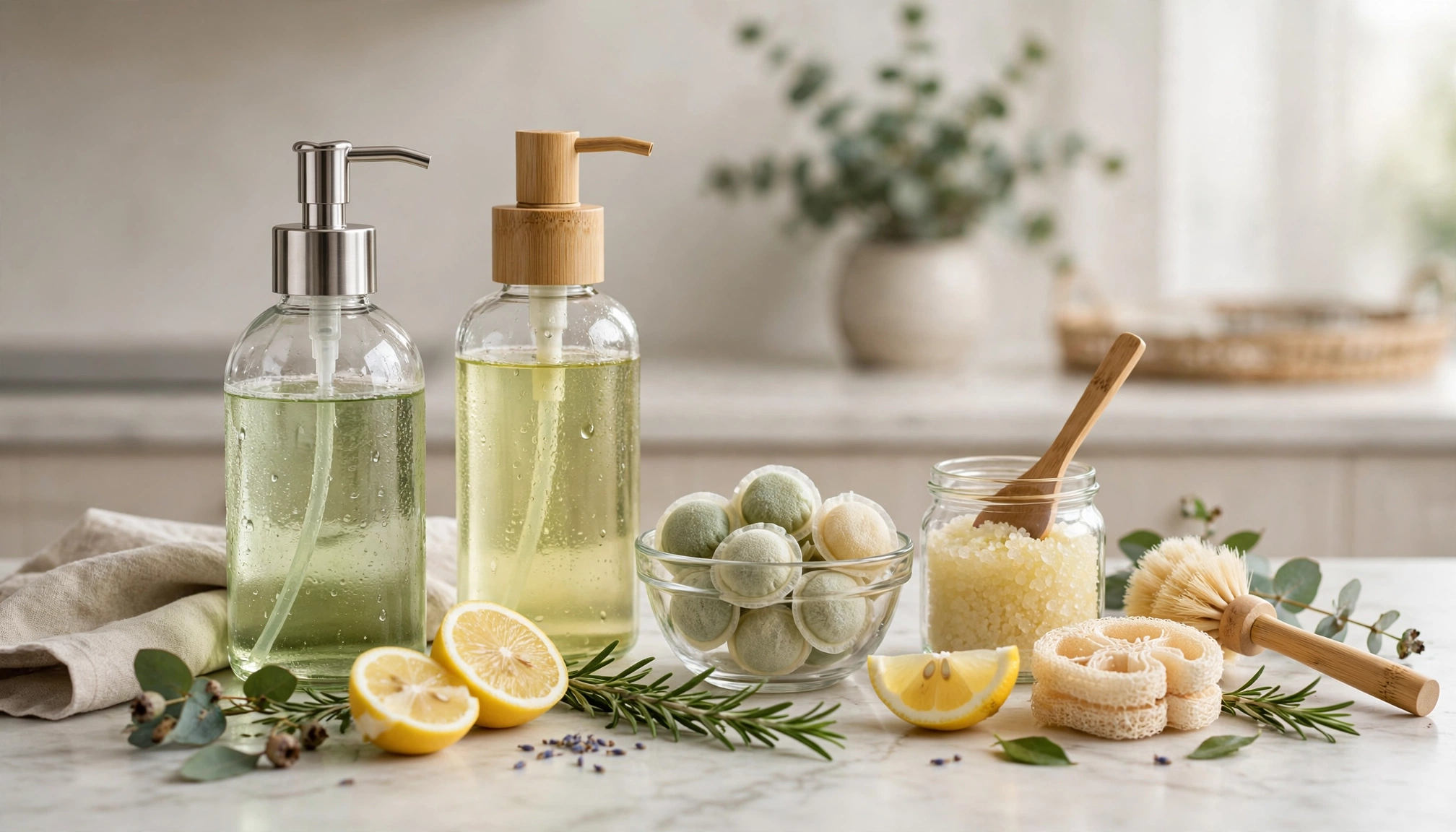
Various eco-friendly cleaning products on a kitchen counter, including refillable bottles, concentrated pods, and plant-based ingredients displayed.
Cost vs. Value: Are Eco-Friendly Cleaners Worth the Price Premium?
This is a common question, and it's a valid one. Yes, there's often an upfront price difference. As mentioned, a 32 fl oz (946 ml) multi-surface eco-friendly cleaner costs about $6.75, compared to $4.20 for a conventional counterpart. That's a 60.7% premium.
However, the "value" extends beyond the sticker price.
Here's my breakdown:
| Feature | Conventional Cleaners | Eco-Friendly Cleaners | Value Proposition