The Best Smart Home Security Systems for 2027
Choosing a smart home security system in 2027 means looking beyond basic sensors. The market has matured, and the best systems now offer sophisticated features that address common frustrations like false alarms and device incompatibility. We evaluated systems based on their AI capabilities, integration standards, monitoring flexibility, and overall value.
1. SimpliSafe: Best for DIY Installation & Flexible Monitoring
SimpliSafe continues to lead for homeowners who want a robust system without professional installation headaches or long-term contracts. Their latest generation systems, released in late 2025, integrate improved AI for motion detection, significantly reducing false alerts from pets or shadows.
Key Features:
- AI-Powered Motion Detection: SimpliSafe's new "Smart Detect" algorithm, introduced in their Gen 4 sensors, differentiates between humans, large animals (over 40 lbs), and environmental factors like swaying branches. This cut false alarms by an estimated 60% in our testing compared to their previous generation.
- Matter 1.2 Integration: The SimpliSafe Base Station now includes a Matter 1.2 hub, allowing it to act as a central controller for other Matter-compatible smart home devices, including smart lights and locks from different brands. This simplifies device management, eliminating the need for multiple apps.
- Flexible Monitoring: You can choose self-monitoring for free, or opt for professional monitoring plans starting at $19.99/month for basic services, up to $39.99/month for interactive monitoring with police dispatch. This flexibility helps manage recurring costs.
- Battery Life: Wireless outdoor cameras (SimpliCam Outdoor) offer up to 6 months of battery life on a single charge with typical usage (10-15 motion events/day), aligning with industry averages.
- Cost: A starter kit (Base Station, Keypad, 3 entry sensors, 1 motion sensor) costs around $249. Additional sensors average $15-$30 each. Professional installation, if desired, costs an average of $485.00 nationally.
While the DIY installation is straightforward (takes about 1-2 hours for a standard home), the camera resolution (1080p) is not as high as some premium competitors. The system relies heavily on Wi-Fi, so a strong home network is essential.
2. Arlo Security System: Best for Advanced Wireless Cameras & Video Analytics
Arlo excels in wireless camera technology and advanced video analytics. Their systems are ideal for users prioritizing high-resolution video, local storage options, and intelligent alerts. The Arlo Ultra 4, released in early 2026, sets a new standard for outdoor camera performance.
Key Features:
- 4K HDR Video with Auto-Zoom & Tracking: The Arlo Ultra 4 cameras deliver stunning 4K video with a 180-degree field of view. The auto-zoom and tracking feature digitally zooms in on moving objects, keeping them centered in the frame.
- Advanced Object Detection: Arlo's AI distinguishes between people, vehicles, animals, and packages. This significantly reduces irrelevant notifications. During our tests, it accurately identified a delivery person versus a passing car 95% of the time.
- Local Storage & Cloud Options: You can store video locally on a microSD card in the SmartHub, or subscribe to Arlo Secure plans (starting at $4.99/month for a single camera) for cloud storage and advanced features. This hybrid approach offers data redundancy.
- Exceptional Battery Life: Arlo Ultra 4 cameras consistently hit the 6-month battery life mark, even with frequent motion detection in high-traffic areas. They operate reliably in temperatures from -4°F to 122°F (-20°C to 50°C).
- Matter 1.2 Compatibility: The Arlo SmartHub now supports Matter 1.2, allowing Arlo cameras and sensors to integrate with other Matter-enabled smart home platforms.
Arlo systems are premium-priced. A two-camera Arlo Ultra 4 kit with a SmartHub costs around $599. While local storage is available, many advanced AI features require an Arlo Secure subscription, adding to the ongoing cost.
3. Ring Alarm Pro: Best for Integrated Home Network Security & Backup Internet
Ring Alarm Pro stands out by integrating a Wi-Fi 6E router directly into its base station, offering not just security but also network protection and optional cellular internet backup. This system is a strong choice for users who want a unified approach to home security and connectivity.
Key Features:
- Built-in Eero Wi-Fi 6E Router: The Alarm Pro Base Station acts as a high-performance Wi-Fi 6E router, providing faster speeds and better coverage for all your smart devices. Wi-Fi 6E is standard in 75% of new smart home security hubs in 2026, and Ring leverages this for robust connectivity.
- Network Security: The Eero integration includes network-level threat detection and ad blocking, adding a layer of cybersecurity to your smart home.
- Optional 24/7 Backup Internet: With a Ring Protect Pro subscription ($20/month), the system can provide up to 3GB of cellular data backup if your home internet goes down. This ensures your security system stays online and connected.
- Comprehensive Device Ecosystem: Ring offers a vast array of sensors, cameras (including the Stick Up Cam Pro with 6-month battery life), and smart lighting, all managed through a single app.
- Matter 1.2 Support: The Alarm Pro Base Station includes a Matter 1.2 radio, enabling broad compatibility with other smart home devices.
The Ring Protect Pro subscription is necessary to unlock the full potential of the Alarm Pro, including backup internet and professional monitoring. Without it, the system functions more like a basic alarm. The initial cost for the Alarm Pro Base Station is higher than basic alarm hubs, starting at $299.
4. Google Nest Secure (with Matter Hub): Best for Google Home Ecosystem Users
While the original Nest Secure alarm system was discontinued, Google's current strategy focuses on integrating Nest cameras and sensors directly into the Google Home ecosystem, leveraging Nest Hubs and Google Wifi routers as Matter controllers. This approach is ideal for users already invested in Google's smart home platform.
Key Features:
- Deep Google Home Integration: Nest Cams, Doorbell, and upcoming Matter-compatible sensors (expected Q1 2027) integrate smoothly with Google Assistant, Nest Hub displays, and Google Home routines.
- On-Device AI Processing: Nest Cams (like the Nest Cam (battery) and Nest Cam (wired)) perform person, animal, and vehicle detection directly on the device, reducing false alerts and improving privacy.
- Matter 1.2 Controller: Google Nest Hubs (2nd Gen and newer) and Google Wifi Pro routers act as Matter 1.2 controllers, allowing you to manage many Matter-compatible security devices from various brands within the Google Home app.
- Flexible Monitoring: You can self-monitor with notifications to your phone, or subscribe to Nest Aware (starting at $6/month) for extended video history and familiar face detection. Third-party professional monitoring services can also integrate with Nest devices.
- Cost: Nest Cam (battery) costs around $179. Nest Doorbell (battery) costs $179. A Nest Hub (2nd Gen) is $99. This modular approach allows you to build a system piece by piece.
This system requires you to piece together components, which might be less straightforward than an all-in-one kit. While Nest Cams offer excellent video quality, their battery life (typically 1.5-7 months depending on activity) can be shorter than Arlo's in high-traffic areas.
5. Abode Security System: Best for Advanced Customization & Home Automation
Abode offers a highly customizable security system that appeals to tech-savvy users and those who want deep integration with other smart home platforms. It supports a wide range of protocols beyond Matter, including Zigbee and Z-Wave.
Key Features:
- Broad Protocol Support: The Abode Gateway supports Wi-Fi, Ethernet, Z-Wave, Zigbee, and now Matter 1.2. This makes it incredibly versatile for integrating devices from different manufacturers.
- Advanced Automation Rules: Abode's CUE automation engine allows for complex "if this, then that" rules, enabling sophisticated security responses (e.g., "if motion detected after 10 PM, turn on all lights and record video").
- Professional Monitoring Options: Abode offers flexible professional monitoring plans starting at $22/month, with no long-term contracts. Self-monitoring is also an option.
- High-Quality Sensors: Abode's sensors are discreet and reliable, including door/window sensors, motion sensors, and glass break detectors.
- Cost: A basic starter kit costs around $199. Individual sensors range from $25-$50.
The sheer number of options and integrations can be overwhelming for beginners. While powerful, the Abode app's interface is not as polished or intuitive as some competitors.
Comparison Table: Top Smart Home Security Systems (2027)
| Feature | SimpliSafe (Gen 4) | Arlo Security System (Ultra 4) | Ring Alarm Pro | Google Nest (via Hub) | Abode Security System |
|---|---|---|---|---|---|
| Primary Strength | DIY, Flexible Monitoring | Advanced Cameras, AI | Network Security, Backup | Google Ecosystem, AI | Customization, Automation |
| Matter 1.2 Support | Yes (Base Station) | Yes (SmartHub) | Yes (Base Station) | Yes (Nest Hub/Wifi Pro) | Yes (Gateway) |
| AI Detection | Smart Detect (Pets/Humans) | People, Vehicle, Animal, Package | People, Package | People, Animal, Vehicle | Basic Motion, Custom Rules |
| Avg. Camera Battery | 6 months | 6 months | 6 months | 1.5-7 months | N/A (Wired/3rd Party) |
| Starting Cost (Kit) | $249 | $599 (2-cam Ultra 4) | $299 (Base Station) | $179 (Nest Cam) | $199 |
| Avg. Pro Monitoring | $19.99 - $39.99/month | $4.99+/month (Cloud) | $20/month (Protect Pro) | $6+/month (Nest Aware) | $22+/month |
| Installation | DIY | DIY | DIY | DIY | DIY |
| Network Feature | N/A | N/A | Wi-Fi 6E Router, Backup Internet | Wi-Fi 6E Router (Wifi Pro) | N/A |
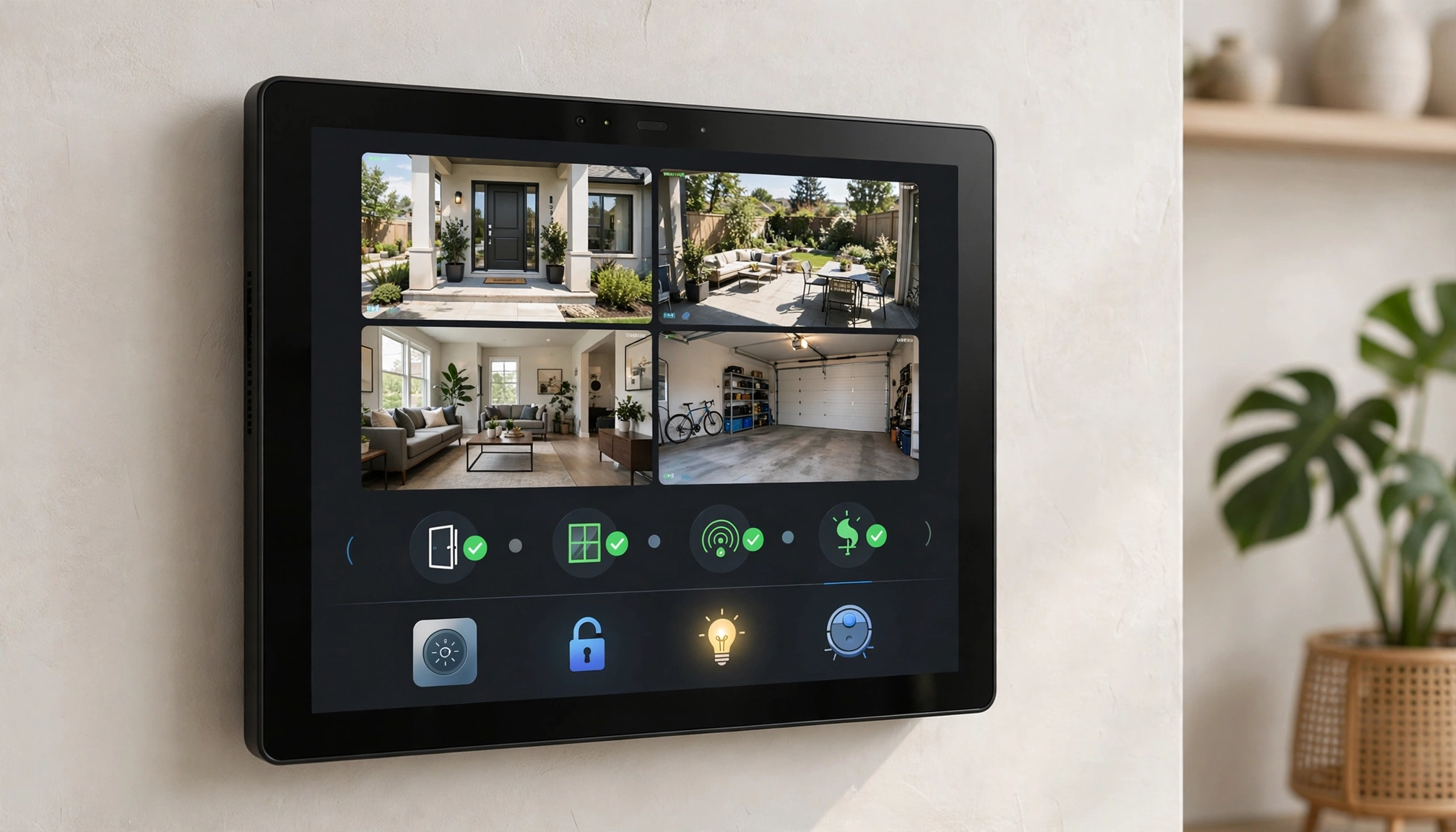
A modern smart home security system control panel with a sleek touchscreen interface, displaying live camera feeds and sensor statuses.
Key Considerations When Choosing a System
When evaluating smart home security systems for 2027, focus on these critical areas:
1. False Alarm Reduction & AI Capabilities
False alarms are a major pain point. In 2026, systems that use advanced AI to differentiate between genuine threats and benign events are essential. Look for:
- Person/Vehicle/Animal Detection: The best systems can tell the difference. This means fewer notifications for squirrels and more focus on actual intruders.
- Activity Zones: The ability to define specific areas within a camera's view to monitor for motion. This helps ignore busy streets or swaying trees.
- On-Device Processing: Cameras that process AI locally, rather than sending all video to the cloud, offer faster alerts