The Real Deal on Minimalist RFID Wallets
Finding a minimalist wallet that actually protects your cards and doesn't turn into a brick after a few weeks is a common challenge. I've tested dozens of these over the years, from cheap knock-offs to premium brands. The market is flooded, and most of them miss the mark on either true minimalism, effective RFID blocking, or practical card access.
The core idea of a minimalist wallet is to carry only what you need, reducing pocket bulk. Adding RFID protection complicates this, as the blocking material itself adds a tiny bit of thickness. The trick is finding a wallet where this addition is negligible and the protection is legitimate, not just a marketing gimmick.
Many people worry about RFID skimming, and while it's a real threat, it's not as widespread as some marketing suggests. In 2025, contactless payment card fraud made up about 0.003% of all card transactions. Still, the peace of mind from RFID blocking is worth it if the wallet performs well otherwise. The National Institute of Standards and Technology (NIST) publishes guidelines on RFID security, which helps define what effective protection looks like.
What Makes a Minimalist RFID Wallet "Good"?
A good minimalist RFID wallet hits three key points:
- True Minimalism: It stays thin even when loaded. The average empty minimalist wallet in 2026 measures 0.4 inches (1.02 cm) thick. Anything significantly more than that defeats the purpose.
- Effective RFID Blocking: It uses materials that genuinely block radio frequencies. Aerospace-grade aluminum (35% of the market) and carbon fiber (30% of the market) are the most common and effective. These materials typically attenuate frequencies between 10 MHz and 3 GHz by at least 95%.
- Practicality: You can get your cards out quickly without a struggle. Some designs are so minimalist they become frustrating to use daily.
Top Minimalist RFID Wallets I've Used & Recommend
After years of carrying, testing, and even dissecting these things, here are the wallets that actually deliver on their promises. I've focused on those that balance slimness, durability, and genuine RFID protection.
1. The Ridge Wallet (Aluminum/Titanium)

Ridge Wallet with cards
The Ridge Wallet is often the benchmark, and for good reason. I've carried an aluminum version for over three years. It's tough. The aluminum plates (or titanium, if you opt for that) sandwich your cards, providing inherent RFID blocking. It holds 1-12 cards comfortably. I typically carry 6 cards and 3-4 folded bills in the cash strap.
- Thickness (empty): 0.23 inches (0.58 cm) for the aluminum version. With 6 cards, it expands to about 0.45 inches (1.14 cm).
- Capacity: 1-12 cards, plus cash strap or money clip.
- Material: Aerospace-grade aluminum or titanium. Both offer excellent RFID blocking.
- Card Access: The thumb notch at the bottom lets you push cards up. It takes a few days to get used to, but then it's fast.
- Price: $75-$125, depending on material and finish. The aluminum version costs around $85.00.
- Pros: Extremely durable, truly minimalist, effective RFID blocking, wide range of colors.
- Cons: Can be pricey, cash strap takes some getting used to, not ideal for carrying many bills.
2. Dango D01 Dapper Wallet
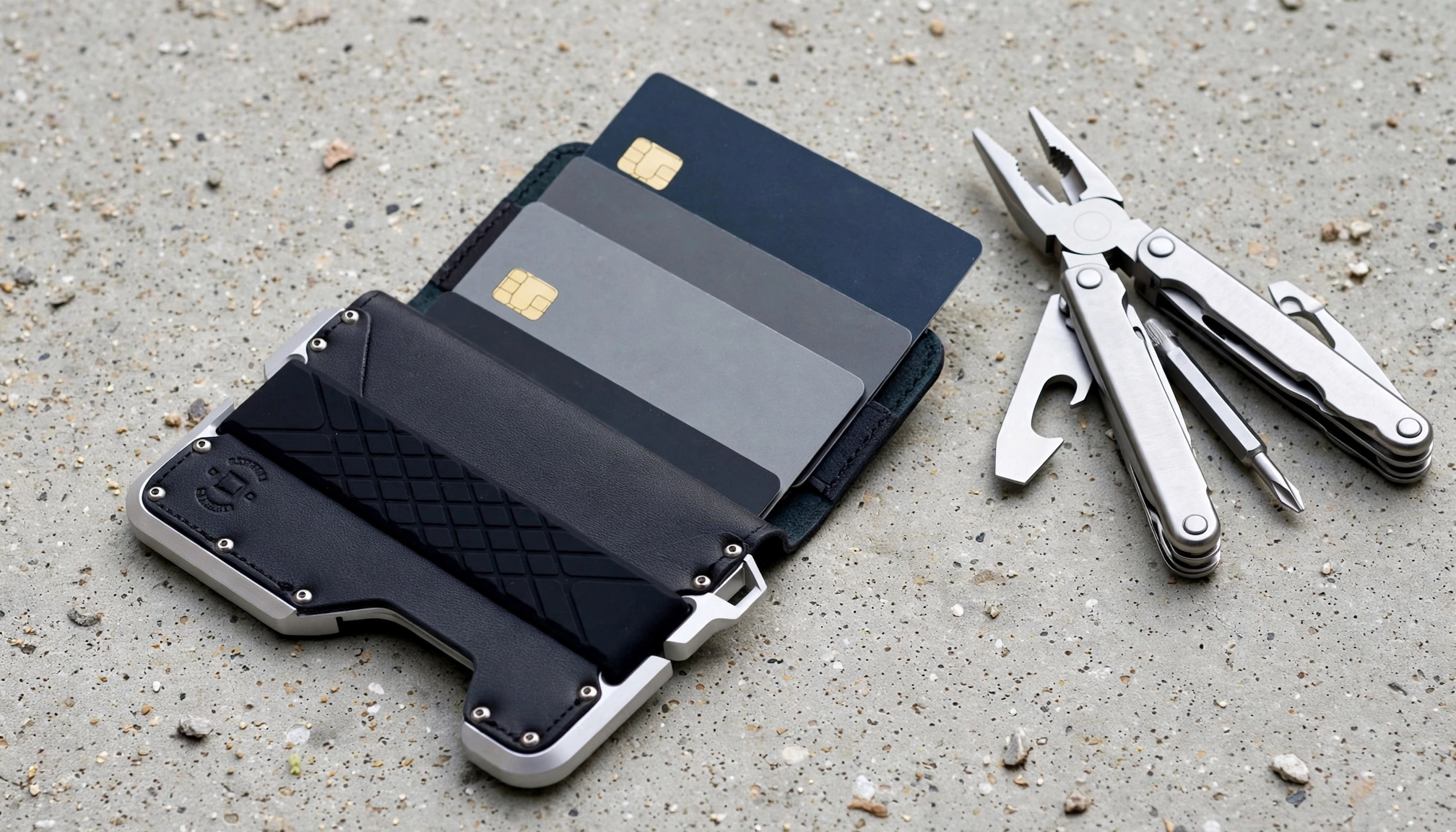
Dango D01 Dapper Wallet with tools
The Dango D01 Dapper is a more refined option, blending aerospace-grade aluminum with genuine leather. This gives it a slightly more traditional look while maintaining a minimalist profile and robust RFID protection. I used a D01 for about a year. The leather breaks in nicely, and the aluminum chassis keeps it rigid.
- Thickness (empty): 0.38 inches (0.96 cm). With 5 cards, it's about 0.5 inches (1.27 cm).
- Capacity: Up to 10 cards, plus a silicone band for cash.
- Material: CNC-machined 6061 aerospace aluminum and top-grain leather.
- Card Access: Cards slide in and out of the aluminum frame. The leather pocket holds additional cards or cash.
- Price: Around $89.00.
- Pros: Combines modern and classic aesthetics, durable, excellent RFID blocking, optional multi-tool accessory.
- Cons: A bit wider than The Ridge, leather can show wear over time (though it develops a nice patina).
3. Trayvax Ascent Wallet
The Trayvax Ascent is a rugged, American-made option that uses a combination of stainless steel and top-grain leather. It's a vertical-carry design, which some prefer. I've had one of these for about six months, and it's built like a tank. The metal plate provides the RFID blocking.
- Thickness (empty): 0.375 inches (0.95 cm). With 4 cards, it stays under 0.5 inches (1.27 cm).
- Capacity: 4-7 cards, plus a small amount of folded cash.
- Material: Stainless steel plate, top-grain leather.
- Card Access: Cards slide into a leather sleeve, secured by a strap. The design makes it easy to fan out cards.
- Price: $70-$85.00.
- Pros: Extremely durable, unique vertical design, excellent RFID protection from the steel plate, made in the USA.
- Cons: Limited cash capacity, can feel a bit stiff initially, not as many color options.
4. Fidelo Minimalist Wallet (Hybrid)
The Fidelo Hybrid is a clever design that offers flexibility. It comes with three interchangeable inner card sleeves (carbon fiber, aluminum, or leather) that slide into an outer leather case. This means you can choose your level of minimalism and RFID protection. I've used the carbon fiber inner sleeve, and it's incredibly light.
- Thickness (empty): 0.3 inches (0.76 cm) with the carbon fiber inner. With 5 cards, it's about 0.48 inches (1.22 cm).
- Capacity: Up to 10 cards, plus cash in the outer sleeve.
- Material: Outer leather case, interchangeable inner sleeves (carbon fiber, aluminum, or leather).
- Card Access: The inner sleeve slides out of the leather case. Cards are pushed up from the bottom of the inner sleeve.
- Price: Around $40-$50.
- Pros: Versatile with interchangeable sleeves, good value, effective RFID blocking with metal sleeves, slim profile.
- Cons: The outer leather can stretch slightly over time, accessing cards from the inner sleeve takes a little practice.
Understanding RFID Protection in Wallets
RFID (Radio-Frequency Identification) technology uses electromagnetic fields to automatically identify and track tags attached to objects. Your credit cards, passports, and some driver's licenses have these tags. An RFID reader can "skim" data from these tags without physical contact.
Effective RFID blocking works by creating a Faraday cage around your cards. This cage blocks the radio waves that readers use to communicate with your cards' chips. Materials like aluminum, carbon fiber, and certain metallic fabrics do this job well. The EMVCo specifications for contactless payments outline the frequencies used, typically 13.56 MHz for payment cards. Good RFID blocking attenuates these frequencies.
A common misconception is that all RFID-blocking wallets are equally effective. Some cheaper wallets use a thin metallic film that can degrade or tear, making the protection unreliable. Wallets made entirely of metal (like The Ridge or Trayvax) or with solid metal/carbon fiber inserts (like Dango or Fidelo's metal sleeves) offer the most robust and durable protection. Consumer Reports has also weighed in on wallet security features, often highlighting the importance of robust materials.
How to Test RFID Blocking (DIY)
You can do a simple, albeit not perfectly scientific, test:
- Find a contactless payment terminal: A self-checkout machine at a grocery store works well.
- Place a contactless card in your wallet: Make sure it's fully enclosed by the RFID-blocking material.
- Attempt to pay: Hold your wallet (with the card inside) against the terminal.
- Result: If the terminal cannot read the card, your wallet is likely blocking the signal. If it reads it, the blocking is insufficient.
Key Considerations When Choosing
| Feature | Minimalist Wallet Standard (2026) | What to Look For