Top 5 Eco-Friendly Cleaning Products for a Sustainable Home in 2027
Moving to eco-friendly cleaning products has become a priority for many households. The global market for these products hits $18.5 billion by the end of 2026, showing a clear shift in consumer demand. This isn't just about feeling good; it's about reducing plastic waste, minimizing exposure to harsh chemicals, and supporting sustainable manufacturing. I've tested numerous brands over the years, and the landscape has changed significantly, especially with concentrated and refillable options.
The biggest challenge people face is finding products that actually clean well. Many assume "natural" means effective, but that's not always true. I've found that the best eco-friendly cleaners balance plant-derived ingredients with robust cleaning power, often leveraging smart formulations rather than just raw chemical strength. Also, the cost factor often deters people, but with refillable systems now widely available, the per-use cost often beats conventional cleaners.
What Makes a Cleaning Product "Eco-Friendly" in 2027?
When I evaluate cleaning products, I look beyond marketing claims. Here's what truly defines an eco-friendly product today:
- Ingredient Transparency: The company clearly lists all ingredients, ideally with their source and function. Look for plant-derived surfactants and avoid phosphates, phthalates, parabens, and synthetic fragrances.
- Third-Party Certifications: These are non-negotiable. Labels like EPA Safer Choice in the US or the EU Ecolabel mean the product has met strict human health and environmental criteria. "Natural" on a label means little without these.
- Concentrated Formulas: This is a game-changer for waste reduction. Concentrates reduce plastic by up to 90% compared to ready-to-use liquids. You add water at home.
- Refillable Systems: Many brands now offer reusable bottles and concentrated refills, cutting down on single-use plastic. Over 12,000 retail locations in the EU and North America offer refill options as of Q3 2026, often saving 20-30% per refill.
- Biodegradability: Ingredients should break down quickly and safely in wastewater. Biodegradable surfactants, for example, typically degrade by 95% within 28 days.
- Sustainable Packaging: Minimal plastic, recycled content, and recyclable or compostable materials are key.
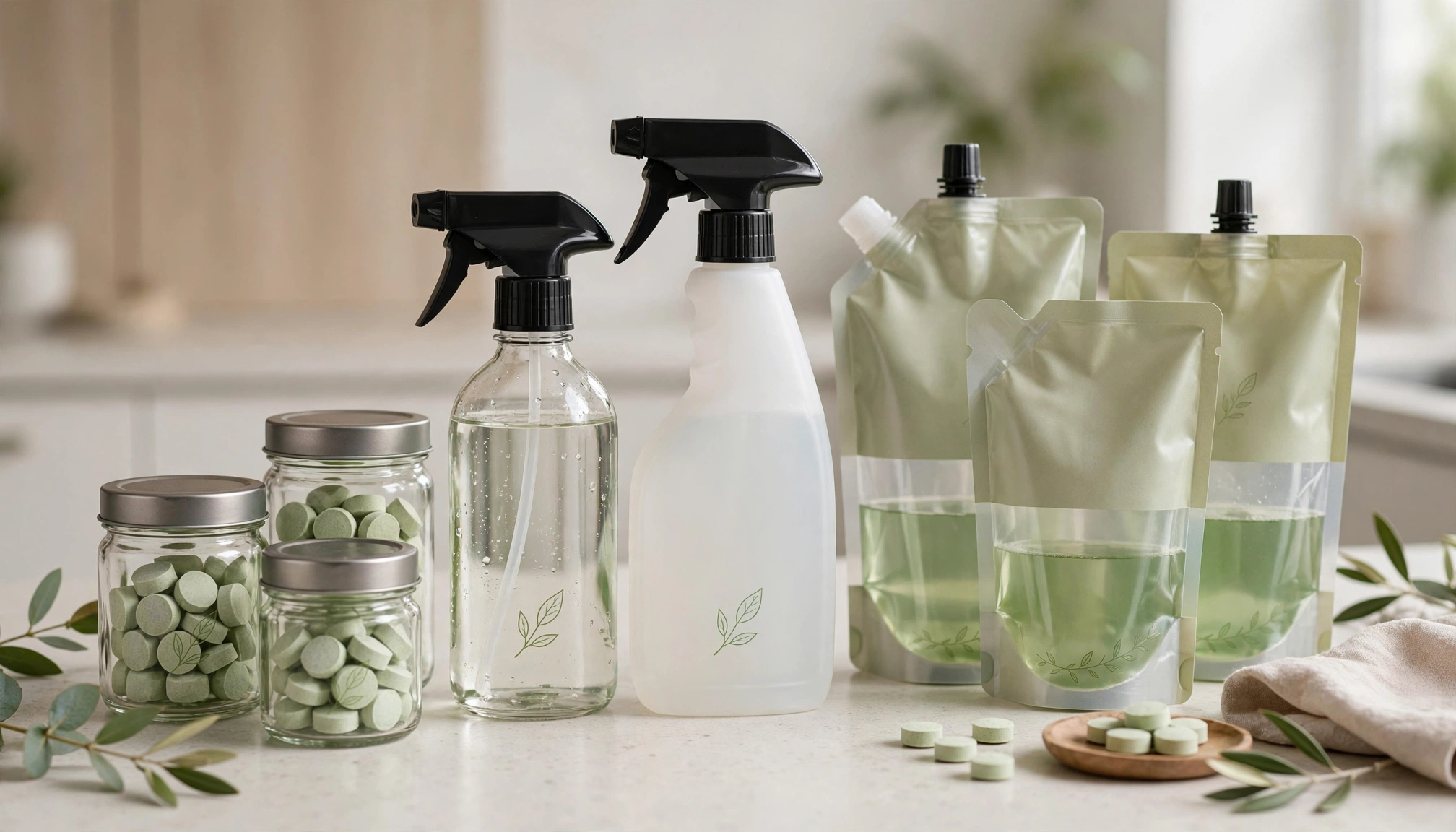
A collection of eco-friendly cleaning products in refillable bottles, with a focus on concentrated tablets and plant-based ingredients.
The Top 5 Eco-Friendly Cleaning Products for 2027
Based on my testing for effectiveness, ingredient safety, packaging innovation, and overall value, these five brands stand out:
1. Blueland (Concentrated Tablets & Refill System)
Blueland has perfected the concentrated tablet model. You buy their reusable glass or acrylic bottles once (a starter kit with three bottles and tablets costs about $29.00), then simply drop a tablet into water to make a full bottle of cleaner.
- Why it's great: Zero-waste packaging for refills. The tablets come in compostable wrappers. Their multi-surface cleaner, glass cleaner, and bathroom cleaner all perform very well on everyday grime. I found the multi-surface cleaner cut through kitchen grease effectively, which is a common complaint with other eco-cleaners.
- Key Ingredients: Plant-derived cleaning agents, citric acid, sodium carbonate. All ingredients are listed clearly on their site.
- Certifications: Cradle to Cradle Certified, EPA Safer Choice.
- Cost: Refill tablets cost around $2.25 each, making a full bottle of cleaner cheaper than most conventional options over time.
- Trade-offs: Initial investment in bottles. Some find the tablet dissolution takes a minute or two.
2. Grove Collaborative (Subscription & Wide Product Range)
Grove Collaborative is more than a brand; it's a platform for sustainable home goods, including their own excellent line of cleaning products. They offer a wide range, from all-purpose cleaners to dish soaps, all with a focus on plant-derived ingredients and refillable packaging.
- Why it's great: Their concentrated refills (often in aluminum bottles or pouches) significantly reduce plastic. Their all-purpose cleaner with orange blossom scent is a favorite for daily use, leaving surfaces clean without streaks. Their glass cleaner works well, even on tough mirror spots.
- Key Ingredients: Plant-derived surfactants (e.g., coco-glucoside), essential oils for fragrance.
- Certifications: Leaping Bunny certified (cruelty-free), many products are EPA Safer Choice.
- Cost: A 16 oz (473 mL) concentrated refill for their all-purpose cleaner costs about $6.99 and makes two full bottles. Their reusable glass spray bottles cost around $14.99.
- Trade-offs: It's a subscription service, which some users dislike, though you can adjust delivery frequency easily.
3. Seventh Generation (Widely Available & Reliable)
Seventh Generation has been a pioneer in eco-friendly cleaning for decades. Their products are widely available in most supermarkets, making them an easy switch for many. They offer a full line, from laundry detergent to dish soap and all-purpose cleaners.
- Why it's great: Consistent performance and transparent ingredient lists. Their Free & Clear All-Purpose Cleaner is excellent for those with sensitivities, cleaning effectively without any added fragrance. I've used their dish soap for years, and it cuts grease as well as any conventional brand.
- Key Ingredients: Plant-derived cleaning agents (e.g., lauramine oxide, caprylyl/myristyl glucoside).
- Certifications: USDA Certified Biobased Product, EPA Safer Choice.
- Cost: A 23 oz (680 mL) all-purpose cleaner costs about $4.50-$5.00. While not always concentrated, they often use recycled plastic in their bottles.
- Trade-offs: Not all products are concentrated, so plastic waste is still a factor, though they use post-consumer recycled plastic.
4. Ecover (European Leader with Strong Performance)
Ecover, a European brand, has a long history of producing effective and environmentally responsible cleaning products. They focus on plant-based and mineral ingredients, with a strong emphasis on biodegradability.
- Why it's great: Their products consistently perform well, especially their dish soap and floor cleaners. The Ecover All-Purpose Cleaner (often citrus-scented) tackles dirt and grime on various surfaces without leaving a sticky residue. Their formulations are designed for quick breakdown in wastewater, aligning with the 95% biodegradability within 28 days standard for many eco-cleaners.
- Key Ingredients: Plant-based and mineral ingredients, including lactic acid and plant-derived surfactants.
- Certifications: EU Ecolabel, Leaping Bunny.
- Cost: A 1-liter (33.8 oz) bottle of all-purpose cleaner costs around $6.00-$7.00. They also offer larger refill sizes.
- Trade-offs: Availability can be spotty in some regions of North America compared to Seventh Generation.
5. Puracy (Natural, Hypoallergenic, and Effective)
Puracy focuses on natural, plant-derived, and hypoallergenic formulas. They are known for their effectiveness, especially their multi-surface cleaner and stain remover, which often outperform conventional alternatives.
- Why it's great: Their Multi-Surface Cleaner is a standout, tackling grease and general dirt without streaks or harsh fumes. It's particularly good on countertops and glass. Their products are often developed by PhD chemists.
- Key Ingredients: Plant-derived surfactants (e.g., decyl glucoside), purified water, natural essential oils.
- Certifications: Leaping Bunny certified, often listed on the EPA Safer Choice list.
- Cost: A 25 oz (739 mL) bottle of multi-surface cleaner costs about $6.99. They offer 64 oz (1.89 L) refill pouches for about $14.99, which significantly reduces plastic waste and cost per use.
- Trade-offs: Some fragrances, while natural, might not appeal to everyone.
Comparison Table: Top Eco-Friendly Cleaners
| Feature / Brand | Blueland | Grove Collaborative | Seventh Generation | Ecover | Puracy |
|---|---|---|---|---|---|
| Primary Format | Concentrated Tablets | Concentrated Refills (Pouches/Aluminum) | Ready-to-Use & Concentrates | Ready-to-Use & Large Refills | Ready-to-Use & Large Refill Pouches |
| Key Certifications | Cradle to Cradle, EPA Safer Choice | Leaping Bunny, EPA Safer Choice (select) | USDA Biobased, EPA Safer Choice | EU Ecolabel, Leaping Bunny | Leaping Bunny, EPA Safer Choice (select) |
| Plastic Reduction | High (zero-waste refills) | High (reusable bottles, concentrated refills) | Moderate (recycled plastic, some concentrates) | Moderate (recycled plastic, large refills) | High (large refill pouches) |
| Cost per Use (Est.) | ~$2.25/bottle (refill) | ~$3.50/bottle (from concentrate) | ~$4.50-$5.00/bottle | ~$4.00/liter (from large refill) | ~$2.30/bottle (from large refill) |
| Grease Cleaning | Good (Multi-Surface) | Good (All-Purpose) | Good (All-Purpose) | Good (All-Purpose, Dish Soap) | Excellent (Multi-Surface) |
| Availability | Online (direct) | Online (subscription) | Widespread retail | Specialty retail, online | Online, some retail |
Practical Tips for a Truly Sustainable Cleaning Routine
Switching products is only part of the equation. Here are my real-world tips for a more sustainable cleaning routine:
- Read Labels Carefully: Don't fall for "greenwashing." Look for specific certifications and ingredient lists. "Natural" means nothing if it's not backed by third-party verification.
- Embrace Concentrates: This is the single most impactful change you can make for plastic reduction. The average North American household uses about 26 gallons (98.4 liters) of conventional cleaning products annually, contributing to significant plastic waste. Concentrates drastically cut this down.
- Use Microfiber Cloths: They clean effectively with less product and are reusable for hundreds of washes. Avoid single-use paper towels.
- Make Your Own (Selectively): For simple tasks, white vinegar and baking soda are effective and extremely cheap. However, these aren't always suitable for all surfaces or heavy-duty cleaning, and commercial eco-cleaners often have better formulations for specific jobs.
- Check for Refill Stations: With over 12,000 locations across North America and the EU, finding a local refill station for liquids is easier than ever. Bring your own bottles and save money.
- Proper Storage: Store concentrates and refills correctly to maintain their efficacy. Keep them in a cool, dry place, away from direct sunlight.